Cost Guide · Checked October 2026
AC Compressor Replacement Cost in Yuma, AZ
As of October 2026, replacing a central AC compressor in Yuma typically costs $1,200–$2,800 parts and labor, with complex jobs running up to $3,500. Nationally the average job lands around $2,300, and the number moves most on two things: the system's size in tons and whether the compressor is still under the manufacturer's parts warranty. Yuma HVAC Repair connects you with a vetted local provider serving the area.
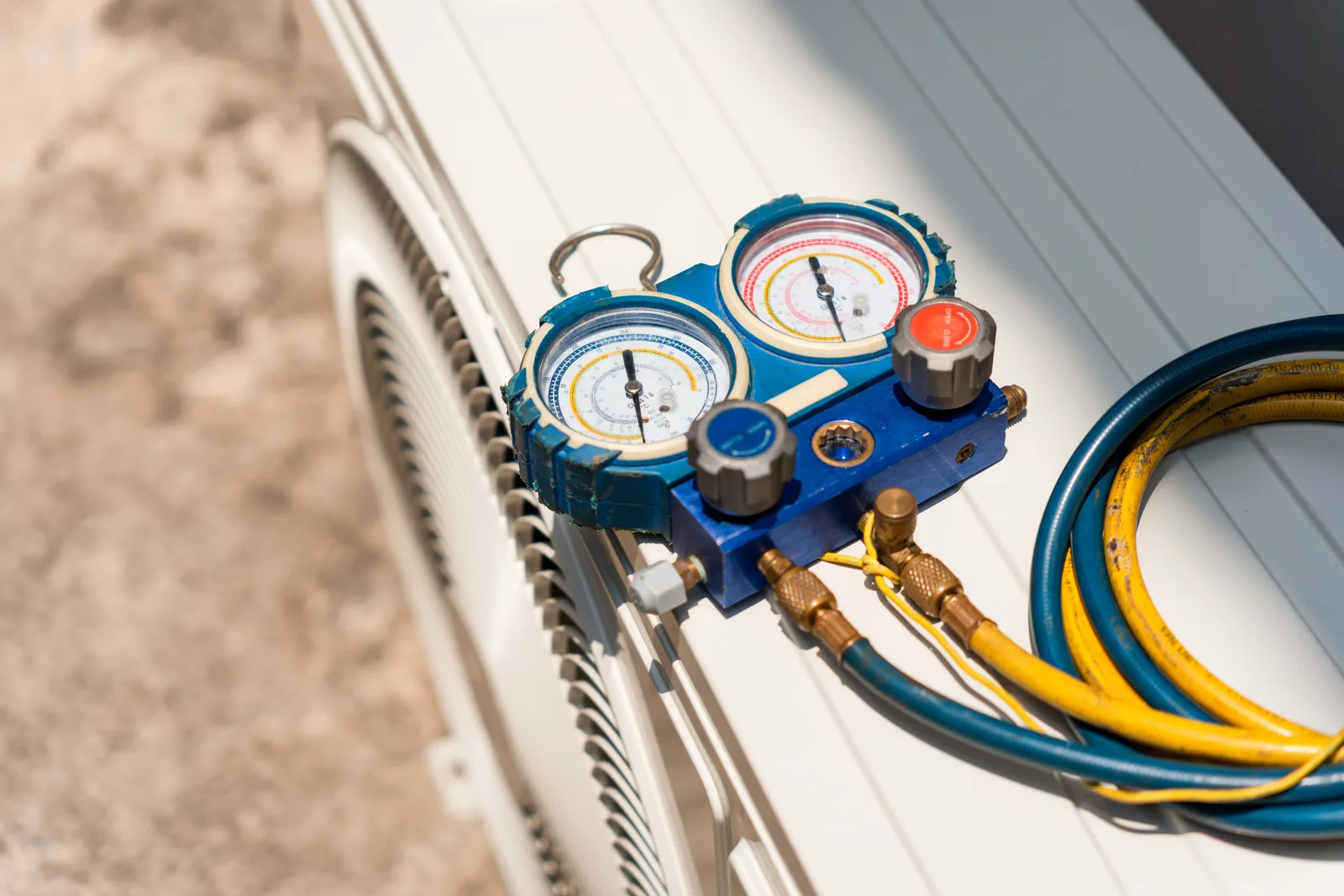
This is the deep-dive behind the compressor row on the AC repair cost guide. A compressor is the single most expensive part in the outdoor unit and the one most likely to force the repair-or-replace decision, so it earns its own page: what the job costs by size and warranty status, how to tell a dead compressor from a $125–$375 capacitor, what Yuma's climate does to the part, and where the math tips toward a new system.
Methodology
The Yuma range is the one this site already publishes on its AC repair cost guide, cross-referenced from national and Arizona cost data in August 2026. The size and warranty breakdowns below are national figures from HomeGuide (member-reported project costs, byline August 2025) and Angi (updated July 2026), read October 20, 2026. No Yuma HVAC company publishes compressor pricing, so every figure here is a benchmark to judge a quote against, not a quote.
Compressor replacement cost by system size
Compressors are sized to the system's cooling capacity in tons, and the part price climbs with tonnage. Which row applies depends on the home's square footage, insulation, and sun exposure; the outdoor unit's data plate carries a model number that encodes the capacity, and any technician can read it off for you.
| System size | Parts + labor (national, 2026) |
|---|---|
| 1.5 ton | $1,500–$2,000 |
| 2 – 2.5 ton | $1,800–$2,200 |
| 3 – 3.5 ton | $2,000–$2,600 |
| 4 – 4.5 ton | $2,200–$2,800 |
| 5 ton and up | $2,500–$3,500+ |
Source: HomeGuide, "How Much Does an AC Compressor Cost?" by Kristen Cramer, Aug 4, 2025 (national project data). HomeGuide's overall band is $1,800–$2,800 with a floor of $1,000 and a ceiling of $5,200; larger systems can exceed $3,000. The site's Yuma band of $1,200–$2,800 overlaps it and starts lower because it includes smaller, warranty-covered jobs.
Under warranty vs. out of warranty
This is the biggest swing on the invoice. Manufacturers warrant the compressor as a part — commonly for a longer term than the rest of the system, and often tied to registering the unit shortly after installation — but the warranty covers the part, not the labor to swap it, the refrigerant to recharge the system, or the filter-drier and other incidentals a proper replacement includes.
| Scenario | Typical total (Angi, national) |
|---|---|
| Compressor under parts warranty (you pay labor + incidentals) | $600–$1,200 |
| Compressor out of warranty (you pay part + labor) | $1,300–$2,500 |
Before approving any compressor quote, find the outdoor unit's data plate, note the model and serial number, and ask the contractor — or the manufacturer directly — whether the compressor is still covered. If the original installer never registered the unit, the covered term may be shorter than the brochure implied; the only way to know is to check. A contractor who quotes a full-price compressor without asking about warranty status has skipped a step that can be worth four figures to you.
What's inside the price
- Labor. A compressor swap is 4 to 8 hours of work for a certified technician: recover the existing refrigerant, cut out the old compressor, braze in the new one, replace the filter-drier, pull a vacuum on the system, and recharge it. At the $75–$150 per hour most Yuma companies bill, labor alone is a meaningful share of the job; Angi reports some companies charge a flat $300–$900 instead of hourly.
- Refrigerant. The system has to be recovered and recharged. On an R-410A system that is $50–$80 per pound, and Angi puts the typical added-refrigerant line at $100–$350. On a pre-2010 R-22 system it is $90–$150 per pound and the whole job can run past $5,000 — see the R-22 note below.
- The diagnosis. The $75–$180 service-call fee on the hub applies here too, and many companies credit it toward the repair. A compressor diagnosis should come with readings — amperage draw, winding resistance, and refrigerant pressures — not just "it's the compressor."
- Related parts that fail with it. A compressor rarely dies alone. The start capacitor and contactor ($125–$375 and $150–$425 as stand-alone repairs) are often replaced in the same visit, and if the failure contaminated the refrigerant circuit, a line flush and new filter-drier are not optional.
- Access and timing. A unit on a flat roof or behind a block wall takes longer; an after-hours call in July carries the emergency surcharge the emergency repair page explains. Ask for the surcharge as a number before agreeing to same-day dispatch.
Is it really the compressor? Rule these out first
"Compressor's gone" is an expensive sentence, and several cheaper failures produce the same symptoms. A good Yuma technician checks these before condemning the part:
- Start capacitor. A compressor that hums, clicks, or will not start — or starts and shuts right back off — is very often a weak or failed capacitor. This is the most common repair on the hub for a reason, and in Yuma's heat capacitors fail on a short cycle.
- Contactor. Pitted or welded contacts can keep the outdoor unit from getting power at all, which looks like a dead compressor from the thermostat.
- Hard-start kit. On a compressor that is struggling to start but not electrically failed, a technician may fit a hard-start kit — a small booster that can buy an aging compressor more time. It is a judgment call, not a cure, and the honest version of the conversation includes how much time it is likely to buy.
- Refrigerant and airflow. Low charge from a leak ($250–$1,500 to find and repair) or a frozen indoor coil from restricted airflow can mimic compressor trouble and, left running, will eventually cause it. If you see ice on the lines, switch the system to fan-only and let it thaw before anyone arrives — the AC not cooling guide walks through the self-checks.
- Electrical supply. A tripped breaker, a failed disconnect, or a loose high-voltage connection at the unit can all read as "the compressor won't run."
A confirmed compressor failure has specific electrical signatures: a grounded or shorted winding, an open winding, or a mechanically seized rotor that draws locked-rotor amperage and trips the breaker every time. Ask the technician which one they found.
Why Yuma kills compressors early
HomeGuide's national compressor lifespan is 10 to 15 years, with a note that in the southern U.S. it may be only 8 to 10. Yuma is the extreme case of that footnote. The outdoor unit sits in 100°F-plus air on most days from June through September, which means the compressor is pushing heat into air that is already hotter than the refrigerant wants to condense against — higher head pressure, higher amperage draw, and more heat in the motor windings, every afternoon, for four months. Three local factors stack on top:
- Run-hours. A Yuma system cools for most of the year, so the compressor logs a four-season system's lifetime of starts and hours in far fewer calendar years — the same reason the AC lifespan guide expects shorter system life here.
- Dust on the coil. Desert dust mats the outdoor coil, and a dirty coil cannot shed heat, which drives head pressure and compressor temperature up further. Coil cleaning at a spring tune-up is the cheapest compressor insurance there is.
- Weak capacitors left in place. A compressor starting against a drifting capacitor draws more current on every start. Catching a low capacitor reading costs a little; letting it take the compressor with it costs a lot.
- West-facing placement. An outdoor unit in full afternoon sun runs hotter than one on a shaded north or east wall. Shade helps; blocking airflow around the unit does not — keep the clearance.
Replace the compressor, or replace the system?
Two tests, and they usually agree. First, HomeGuide's guidance: replacing only the compressor makes sense when the unit is under about 8 years old and the part is still under warranty; consider a full replacement when the compressor is out of warranty, the unit is more than 10 years old, it has a history of other problems, or the repair is 50 percent or more of a new unit's price. Second, the hub's $5,000 rule: multiply the quote by the system's age in years. A $2,800 compressor on a 6-year-old system comes in under the line; the same quote on a 9-year-old system does not.
The Yuma adjustment is that the rest of a 9- or 10-year-old system — fan motor, contactor, coil — has lived the same hard life as the compressor, so a new compressor in an old condenser tends to be the first of several bills rather than the last. With central AC replacement at $4,500–$9,500 and a full system at $6,000–$13,000 with existing ductwork (the HVAC replacement cost guide has the breakdown), an out-of-warranty compressor on a system past that age threshold is usually the moment to price both and compare the per-year cost, not just the invoice.
The R-22 problem
If the system went in before roughly 2010 it likely runs on R-22, which is no longer produced and costs $90–$150 per pound against $50–$80 for R-410A. A compressor replacement on an R-22 system means buying scarce refrigerant and a compressor built for it, and HomeGuide puts that job at more than $5,000. At that price the replacement math above stops being close: the system is well past 10 years old by definition, and a new unit costs little more than keeping the old one alive. Ask which refrigerant the system uses before anything else — it is printed on the outdoor unit's data plate.
Getting a fair compressor quote
- Ask what was tested to rule out the capacitor, contactor, and electrical supply before the compressor was condemned, and ask for the readings.
- Check the compressor's warranty status from the data plate before accepting a full-price part.
- Get the estimate in writing with the compressor, labor, refrigerant, filter-drier, and any flush listed separately.
- Ask whether the diagnostic fee is credited toward the repair, and what the emergency surcharge is if the call is after hours.
- Ask for a replacement quote in the same visit if the system is near 10 years old, so you can compare both numbers on the same day.
- Confirm the company's Arizona ROC license — the lookup walkthrough is in the Best HVAC Companies guide.
Sources, read October 20, 2026: HomeGuide, "How Much Does an AC Compressor Cost?" by Kristen Cramer, Aug 4, 2025 (national project data) (https://homeguide.com/costs/ac-compressor-cost); Angi, "How Much Does an AC Compressor Cost to Install?" by Haley Nothstein, updated Jul 9, 2026 (https://www.angi.com/articles/ac-compressor-cost.htm); the Yuma repair and replacement bands are the ones this site already publishes on its cost guides (cross-referenced national and Arizona data, verified August 13, 2026). Climate: NOAA NCEI climate normals as compiled for Yuma (100°F+ on most days June–September).
Frequently Asked Questions
How much does it cost to replace an AC compressor in Yuma?
As of October 2026, a compressor replacement in Yuma typically runs $1,200–$2,800 parts and labor, with complex jobs up to $3,500; the national average is about $2,300. If the compressor is still under the manufacturer's parts warranty you pay labor and incidentals only, which Angi puts at $600–$1,200 nationally.
Is it worth replacing the compressor or should I replace the whole AC?
Replace just the compressor when the system is under about 8 years old and the part is still under warranty. Replace the whole system when the compressor is out of warranty, the unit is more than 10 years old, it has a history of other repairs, or the quote reaches roughly 50 percent of a new unit's price — in Yuma that line is crossed sooner than the national guidance implies, because the rest of the system has logged the same hard hours as the compressor.
How long does an AC compressor last in Yuma?
Nationally 10 to 15 years, but in hot southern climates HomeGuide puts it at 8 to 10. Yuma sits at the hard end of that: the compressor runs through 100°F-plus days on most days from June through September, so a Yuma compressor logs in eight summers what a four-season system logs in fifteen.
Why is a compressor on an older R-22 system so expensive to replace?
Because R-22 refrigerant is no longer produced and runs $90 to $150 per pound, a compressor replacement on a pre-2010 R-22 system can run more than $5,000 once the refrigerant and the matching parts are priced in. At that number, a full AC replacement at $4,500–$9,500 is almost always the better spend.
Can a bad capacitor look like a bad compressor?
Yes, and it is the first thing a good technician rules out. A compressor that hums and will not start, or trips the breaker on start-up, is often a failed start capacitor — a $125–$375 repair, not a $1,200–$2,800 one. Ask what was tested before accepting a compressor diagnosis.
Do you replace compressors yourselves?
No. Yuma HVAC Repair is an independent guide, not an HVAC contractor — we connect you with independent, third-party providers who do the work. Verify any company's Arizona ROC license before booking.